
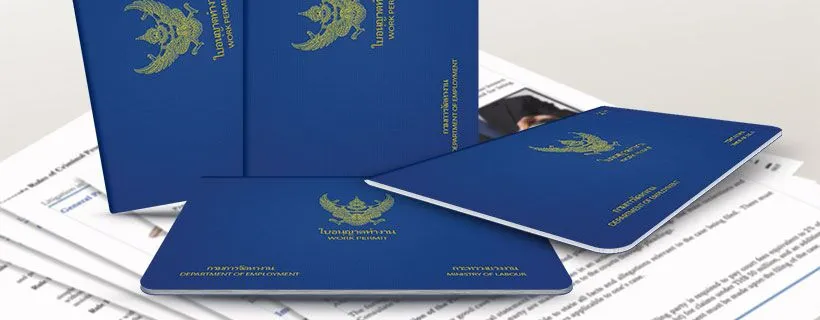
A Thai work permit is a legally required authorization allowing foreign nationals to engage in employment or business activities within Thailand. The regulation of foreign labor reflects Thailand’s broader policy objective of balancing economic development with protection of the domestic workforce. As a result, employment by foreigners is strictly governed through statutory controls involving immigration status, employer qualifications, occupational restrictions, and ongoing compliance obligations.
Contrary to common misunderstanding, holding a visa alone does not grant permission to work. A foreign national may only perform work in Thailand after obtaining a valid work permit issued by the Department of Employment under the Ministry of Labour. Understanding the legal framework governing work permits is essential for both employers and foreign employees to avoid administrative penalties and potential criminal liability.
Legal Framework Governing Work Permits
Thai work permits are primarily regulated under the Foreigners Working Management Emergency Decree B.E. 2560 (2017) and its subsequent amendments. The law defines “work” broadly as any activity involving physical or intellectual effort performed for compensation or benefit.
This definition extends beyond traditional employment and may include:
-
Managing or directing company operations
-
Providing professional services
-
Consulting or advisory roles
-
Supervising staff
-
Performing technical or skilled labor
Even unpaid participation in business activities may be interpreted as work under Thai law if economic benefit is derived.
Relationship Between Visa and Work Permit
A work permit cannot exist independently of immigration status. Foreign nationals must first obtain an appropriate Non-Immigrant visa, commonly including:
-
Non-Immigrant B (Business Visa)
-
Non-Immigrant O (Dependent or spouse-based employment eligibility in certain cases)
-
Investment or Board of Investment (BOI) visas
The visa authorizes entry and residence, while the work permit authorizes employment activity. Both must remain valid simultaneously throughout employment.
Employment conducted without either authorization constitutes illegal work regardless of contractual arrangements.
Employer Eligibility Requirements
Thai authorities evaluate not only the foreign employee but also the sponsoring employer.
Standard corporate requirements generally include:
-
Registered Thai company status
-
Minimum paid-up capital (commonly THB 2 million per foreign employee)
-
Proper business licensing
-
Active tax registration
-
Demonstrated operational activity
Additionally, companies typically must maintain a ratio of Thai employees to foreign workers, often interpreted as four Thai employees per foreign work permit, although exemptions may apply in promoted industries or specialized sectors.
These requirements reflect government policy encouraging skills transfer rather than labor substitution.
Work Permit Application Process
The work permit application involves coordinated submission by both employer and employee.
Step 1: Corporate Documentation Preparation
The employer submits company documents such as:
-
Company affidavit
-
shareholder list
-
financial statements
-
VAT registration
-
office location evidence
Authorities review whether the business legitimately requires foreign expertise.
Step 2: Employee Qualification Submission
The foreign applicant must provide:
-
passport copies
-
educational certificates
-
professional experience records
-
medical certificate issued in Thailand
-
photographs meeting official specifications
Educational qualifications are often assessed against the proposed job description to confirm suitability.
Step 3: Application Review and Approval
The Department of Employment reviews compliance with labor regulations, occupational eligibility, and corporate capacity.
Once approved, the foreign employee receives a physical or electronic work permit specifying:
-
employer name
-
job position
-
workplace location
-
permitted activities
Employment outside these parameters is prohibited.
Restricted Occupations for Foreign Nationals
Thailand maintains a list of occupations reserved exclusively for Thai nationals to protect domestic employment opportunities.
Restricted fields generally include:
-
manual labor occupations
-
retail trading roles
-
administrative clerical work
-
traditional crafts and services
-
certain construction and agricultural activities
Foreign nationals may only work in positions not prohibited under ministerial regulations. Employers must therefore ensure job descriptions accurately reflect permitted professional or managerial roles.
Scope and Limitations of Work Authorization
A work permit strictly limits employment scope.
Foreign employees may only:
-
work for the approved employer,
-
perform the registered job function,
-
operate at the designated workplace.
Changes involving employer, job role, or office location require amendment or issuance of a new permit.
Temporary assignments outside registered locations may require prior authorization from labor authorities.
Failure to comply may result in permit cancellation even where employment remains otherwise lawful.
Employer and Employee Compliance Obligations
Work permit compliance continues throughout employment.
Employer Responsibilities
Employers must:
-
notify authorities of employment commencement
-
report termination within statutory deadlines
-
maintain payroll and tax compliance
-
ensure foreign employee duties match approved position
Employee Responsibilities
Foreign employees must:
-
carry or maintain accessible work permit documentation
-
notify authorities of address changes
-
comply with immigration reporting obligations
-
renew permits prior to expiration
Non-compliance may affect both immigration status and future employment eligibility.
Renewal and Extension Procedures
Work permits are typically issued for one year or aligned with visa validity.
Renewal requires confirmation that:
-
employment continues legitimately,
-
tax filings remain compliant,
-
corporate financial standing remains adequate.
Applications should be submitted before expiration to avoid interruption of lawful employment status.
Simultaneous renewal of visa extensions is commonly required through Immigration Bureau procedures.
Penalties for Non-Compliance
Thai labor law imposes substantial penalties for unauthorized employment.
Foreign nationals working without a valid permit may face:
-
monetary fines,
-
deportation,
-
prohibition from re-entry.
Employers allowing illegal employment may incur higher fines and potential business liability.
Authorities increasingly conduct workplace inspections, particularly in industries employing foreign professionals.
Special Work Permit Categories
Certain sectors benefit from streamlined procedures.
Examples include:
-
Board of Investment (BOI) promoted companies
-
Eastern Economic Corridor (EEC) projects
-
Highly skilled professionals under special investment programs
These frameworks may reduce documentation requirements and accelerate approval timelines while maintaining regulatory oversight.
Practical Considerations for Foreign Professionals
Obtaining a work permit involves coordination between immigration law, labor regulation, and corporate compliance. Delays frequently arise from incomplete documentation, inconsistent job descriptions, or insufficient corporate capitalization.
Foreign professionals should ensure that employment arrangements reflect genuine operational roles rather than nominal appointments designed solely for visa purposes. Authorities increasingly evaluate substance over form when reviewing applications.
Maintaining compliance throughout employment is equally important, as violations may affect long-term residency options or future business activities in Thailand.
Conclusion
The Thai work permit system serves as the legal foundation regulating foreign participation in the national workforce. By requiring alignment between immigration status, employer qualifications, and occupational eligibility, Thailand seeks to promote responsible employment while safeguarding domestic labor interests.
For foreign employees, a work permit provides lawful authority to engage in professional activity and remain compliant with Thai labor law. For employers, adherence to regulatory obligations ensures operational stability and minimizes legal exposure.
A properly obtained and maintained work permit allows foreign professionals to work in Thailand securely and predictably within a clearly defined legal framework, supporting both economic participation and long-term professional engagement in the country.